Electric underfloor heating in Blacktown
We install electric underfloor heating across Blacktown, where open fires and wood heaters are not permitted at all in the growth precincts. There are 98,390 separate houses here, which is the second largest count in the state, and 45.8% of all homes have four bedrooms or more. About 4,198 new homes a year are approved, more than in any other Sydney area. Two weather stations have stood inside this boundary, and the one at Seven Hills recorded 12 nights a year at or below 2°C. In slab heating cable and under tile heating mats are both ordinary work here, and the slab comes first.
The benefits of electric underfloor heating in Blacktown
Separate houses are 81.1% of homes here and flats only 6.7%, which is the lowest flat share we have measured anywhere. Two of the reasons below exist only in the suburbs built since 2010. The others come from a network that charges differently from the rest of Sydney.
No open fire or wood heater in the growth precincts
The plan covering the growth precincts says open fireplaces, wood fired heaters and slow combustion stoves are not permitted. The benefit of in slab heating cable is that it needs no chimney, no flue and no fuel delivered to the door. Those precincts are where most of the new houses in this area are being built.
The biggest new housing pipeline in the state
About 2,438 new houses a year are approved in this area, which is first of all thirty nine. In slab heating cable is tied to the reinforcing mesh before the pour, so it adds no floor height. The benefit is a heated floor decided with the plans rather than added years later at a doorway.
Council requires a pale roof on all development here
Council's plan says all developments must meet a minimum reflectivity figure across 75% of the roof. It has said so since February 2026, and it is a rule about keeping summer heat out rather than winter. Nothing in it reaches the floor or the heating inside the house at all. The benefit is that our thermostats run the floor heating on a timer, so it warms before the evening peak and then holds.
The largest solar fleet of any area in Sydney
There are 62,425 solar systems on roofs here, which is more than in any other area in Sydney. Around The Ponds that reaches 62.5% of houses, and charges on this network are lowest in the middle of the day. In slab and in screed heating cable carry extra mass, so they keep giving heat back long after the circuit stops. So the benefit is a floor giving heat back at seven in the evening, from power made at noon.
No conservation area anywhere in this boundary
Under tile heating mats go into a bathroom retile here with no heritage question in the way. There are 116 heritage items in this area and not one conservation area anywhere inside the boundary. Not one of those items lists an interior, and Council's position is that only structural interior changes need consent.
A filled lot changes how the floor is built
Council applies a standard restriction saying no building shall be erected on a filled lot unless it sits on pier and beam footings. The alternative is footings or a slab designed and certified by a chartered professional engineer. In the growth precincts foundations and brickwork must also have sulphate resistant properties. In slab heating cable ties into the certified slab, and in screed heating cable suits pier and beam instead. The benefit is that either footing design still takes a heated floor.
What we would install in Blacktown
About 2,438 new houses a year are approved here, which is more than in any other area in the state.
Cable in a slab
This is the one area where a new slab is the usual starting point rather than the exception. In slab heating cable is tied to the reinforcing mesh and the concrete is poured over the top of it.
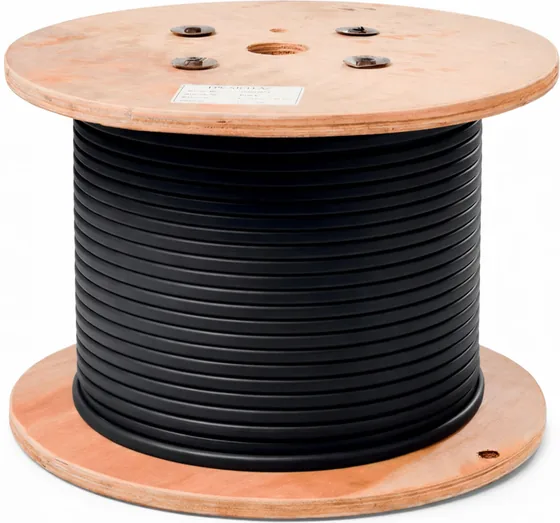 Slab heating cables, dual core
A mat under the tiles
A bathroom in one of the older Blacktown or Mount Druitt streets is the retrofit job. Under tile heating mats raise the finished floor by only a few millimetres, so the threshold is kept.
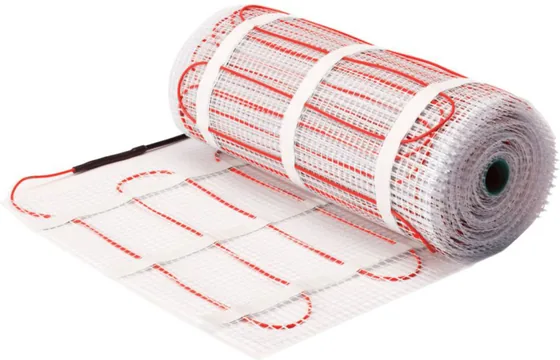 Under tile heating mats
Cable in a screed
A screed suits a room added onto a house that already stands, and it adds mass the old floor lacks. In screed heating cable goes down with the topping, and the mass it adds is what the old floor was missing.
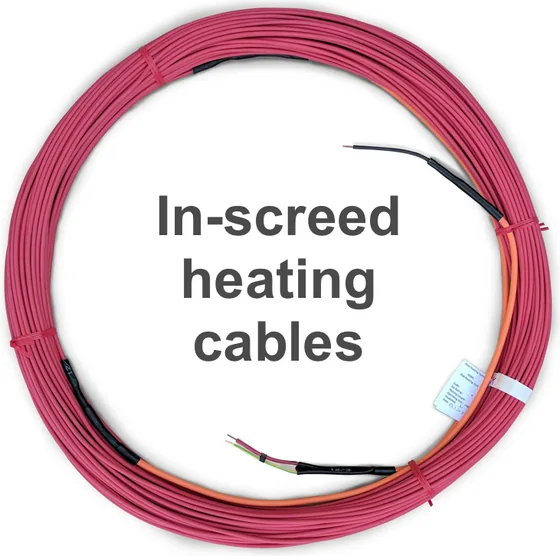 In screed heating cable
Why Blacktown properties choose us
We install across Blacktown and the rest of the Blacktown area, and we size every job from your floor plans before we quote. Installation is always subject to checking installer availability, which we do before we agree a day.
How we install underfloor heating in Blacktown
Plans first, then a quote
Send us the plans for your new home, renovation, office or hotel. We measure the heated areas from them, calculate the cable size and quote the materials. If you want us to install, a second quote covers the installation labour. Nothing is ordered and no day is booked until you accept.
Installation day
Once you accept and tell us the job site is ready, we agree a day, subject to checking installer availability. The floor has to be prepared and ready before that day: your own trades handle levelling, waterproofing and anything else above the slab. Our installer lays the cable or the mat, fits the thermostat, and tests the system with our own equipment before leaving site. Your tiler covers it with the screed or the tile bed.
In a strata building the path is different again
In a New South Wales strata scheme the lot boundary generally sits at the upper surface of the floor. The slab underneath belongs to the building rather than to you. We lay the mat into the tile bed instead of touching that slab, and nothing is drilled or chased into it. Installing hard flooring, and the wiring and power points that come with it, is a minor renovation under the Strata Schemes Management Act 2015. Waterproofing is carved out of that definition, so a full bathroom rebuild goes to a special resolution rather than an ordinary one. Your builder or project manager deals with the owners corporation, and we build to whatever that approval allows.
No permits, and ten days for the road
Most kerbs in this area are unrestricted, so there is no tradesperson parking permit to apply for and none is needed. A skip costs a resident nothing on private land and needs no notice there. On the road it goes through a company Council has registered. A road occupancy approval takes up to ten business days, and that is the only waiting period in the sequence. Council's standard condition puts offensive noise generating work at 7am to 6pm on weekdays and 8am to 1pm on Saturday. Quiet work inside a building is not what that condition is aimed at, and most of our day is quiet work. What does move a date here is the growth area paperwork. Every new lot is classified under the Australian standard for reactive soils, and a filled lot carries a restriction about its footings. Those are settled with the engineer first, and in slab heating cable is set out once that detail is fixed.
Underfloor heating for Blacktown homes
The largest council in the state, and almost all houses
There are 98,390 separate houses here, which is the second largest count in New South Wales. They are 81.1% of homes, against a flat share of 6.7% that is the lowest we have measured. 55,551 homes have four bedrooms or more, which is the most of any council in the state. The house count went from 74,606 in 2006 to 98,390 in 2021, so about a quarter of today's houses arrived after 2006. Flats roughly doubled across the same years, from 4,180 to 8,158, and 72% of them sit in blocks of four storeys or more. Under tile heating mats answer the town centre flat, and a four bedroom house is usually a whole heated floor.
Five different housing markets in one boundary
The Mount Druitt estates hold about 10% of the homes here and 87% of those are houses. The established ring around Blacktown and Mount Druitt holds 42% of the homes and 64% of the flats. The owner estates built between 1971 and 2007 hold 27%, with Glenwood at 83% of homes carrying four bedrooms or more. The growth area opened in 2010 holds 21%, where 86% are houses and Colebee reaches 92.6% at four bedrooms or more. Marsden Park and Shanes Park are the extreme, where 92% of the homes standing in 2021 did not exist in 2011. The Ponds has 4,673 homes and only 32 strata plans, because those estates are titled another way. In slab heating cable suits the growth area and under tile heating mats the established ring.
Flood rules here name the power points
Council's plan says power points and communication facilities are to be set at the flood planning level or higher. Electrical equipment below the probable maximum flood must not obstruct flow, and that list names meter boxes, battery storage, solar inverters and charging points. Freeboard is half a metre on the rivers and 300mm on an overland flow path. A habitable floor goes at the flood planning level or at least 225mm above finished ground, whichever is higher. The largest flood on record here was in 1867 and it reached Riverstone, Schofields, Marsden Park and Shanes Park. New controls for the South Creek catchment apply from November 2026, so your own flood planning level is worth checking. Our thermostat is the only part of the heating that has to sit above that line.
Winter mornings in Blacktown
Two stations have stood inside this area, at Prospect Reservoir and at Seven Hills in Collins Street.
- July nights
6.1°C at Prospect Reservoir station 067019 inside this area, against 8.1°C at Observatory Hill. A tiled floor sits close to that overnight, and it is the first thing a bare foot meets in the morning.
- Frost
3 nights a year at or below 2°C at Prospect Reservoir, and 12 at Seven Hills in Collins Street. The overnight low is what decides how cold the floor is at seven in the morning.
- Summer
12 days a year at or above 35°C at Seven Hills and 11 at Prospect Reservoir. Heating is a winter item here, and a thermostat on a timer draws nothing for the rest of the year.
- Climate zone
Zone 6 across the whole area, from Seven Hills out to Marsden Park and Riverstone. Insulation under the heating is what keeps the warmth in the room, and it is sized from that zone.
Get a free quote in Blacktown
Tell us what you need done in Blacktown and we will get back to you with a price as soon as we can. There is no obligation to go ahead.
Services we provide in Blacktown
New home builds
Home renovations
Bathroom renovations
Apartments
Hotel bathrooms
Office buildings
Cold storage and frost heave
Suburbs we service in Blacktown and surrounds
We install across the Blacktown area and the surrounding localities, and we check installer availability before we agree a day. If your suburb is not listed below, contact us and we will confirm coverage.
Frequently asked questions about Blacktown
Do you cover every suburb in the Blacktown area?
Yes. We install across the Blacktown area and the surrounding localities, including every suburb listed on this page. We check installer availability before we agree a day, which is the one condition that travels with every job. If your suburb is not shown, contact us with the address and we will confirm coverage before we quote.
What are your service hours in Blacktown?
Our hours are Monday to Friday, 8am to 5:30pm, and we are closed on Saturday and Sunday. Plans and photographs can be sent at any time through the quote form on this page. If you need us on site in Blacktown, the day is agreed once we have checked installer availability. It is worth sending the plans as early as you can.
Am I allowed a wood heater in a new estate here?
No, not in the growth precincts. The plan covering them says open fireplaces, wood fired heaters and slow combustion stoves are not permitted. That reaches Alex Avenue, Riverstone, Area 20, Schofields, Marsden Park, West Schofields and Riverstone East. Outside those precincts a heater follows the usual approval route instead. Under tile heating mats and in slab heating cable need no chimney and no flue, so both are allowed either way.
Where do the power points have to go?
Above the flood planning level, if your lot sits inside the flood planning area. Council's plan says power points and communication facilities are to be set at that level or higher. Electrical equipment below the probable maximum flood must not obstruct flow, and that list names meter boxes, battery storage and solar inverters. In slab heating cable sits inside the floor itself, so our thermostat and the circuit are the parts that answer the rule.
How cold does it actually get out here?
Colder than the coast, and the two stations inside this area disagree a little. Prospect Reservoir, now closed, averaged 6.1°C on July nights and 3 nights a year at or below 2°C. The Seven Hills station in Collins Street recorded 4.5°C and 12 such nights. Observatory Hill in the city averages 8.1°C and records none at all. The benefit of under tile heating mats is a warm tile floor on the coldest of those mornings.
Does the heritage list matter on a house here?
No, less than almost anywhere. There are 116 listed items in this area and not a single conservation area, which is true of only one other area we cover. Not one of those items lists an interior. Council's stated position is that consent is needed only for a structural change inside. Riverstone carries 31 of them and twenty of those are houses. So unless your own address is one of the 116, under tile heating mats need nothing from Council.
Will the soil report on a new lot change the floor?
Yes, it decides what the floor actually is. Council classifies every new lot here under the Australian standard for reactive soils. A standard restriction says no building shall be erected on a filled lot unless it sits on pier and beam footings. The alternative is footings certified by a chartered professional engineer. Growth precinct foundations and brickwork must also carry sulphate resistant properties. In slab heating cable goes into a certified slab and in screed heating cable into a pier and beam floor.
Explore our other Sydney service areas
Ready to get started?
Get a free quote for your job in Blacktown, or call now and speak to someone who can help.