Slab heating cables - dual core
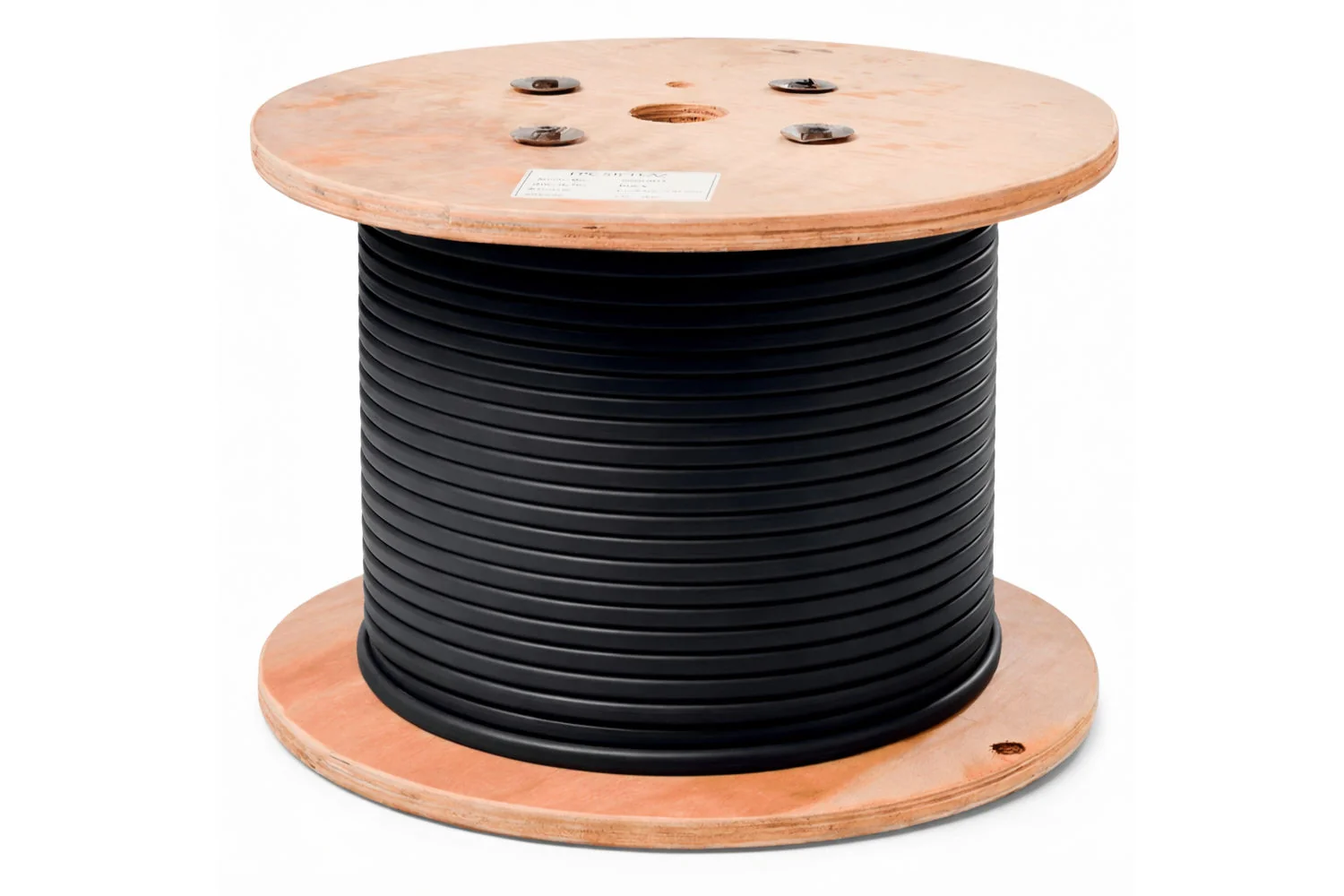
Dual core slab heating cable for a new concrete slab, with the return built in so only one end comes back to the thermostat.
In stock
Free delivery Australia wide on orders of $100 and over, in 3 to 5 business days. $15 delivery below $100. Or pick up free from Ingleburn. Not sure it is the right part? Call 02 9829 2752.
About the Slab heating cables - dual core
Dual core slab heating cable goes into a new concrete slab before the pour, the same as our single core cable.
Both conductors run inside the one cable, with the return built in. The heating cable finishes where planned.
Spacing calculations are available.
Description:
- Evenly spaced fluoropolymer dual-core heating elements ensure consistent heat output.
- Unique return cable design allows a single connection to the thermostat.
- 2m flexible two-core power lead (cold tail) with earth braiding and insulated outer sheath.
- Primary heat source when used with proper home insulation, delivering faster heat-up times.
Where dual core is the right choice
- A new slab where the room shapes are awkward.
- A slab that will be polished and left as the finished floor.
How the heating cable goes into the slab
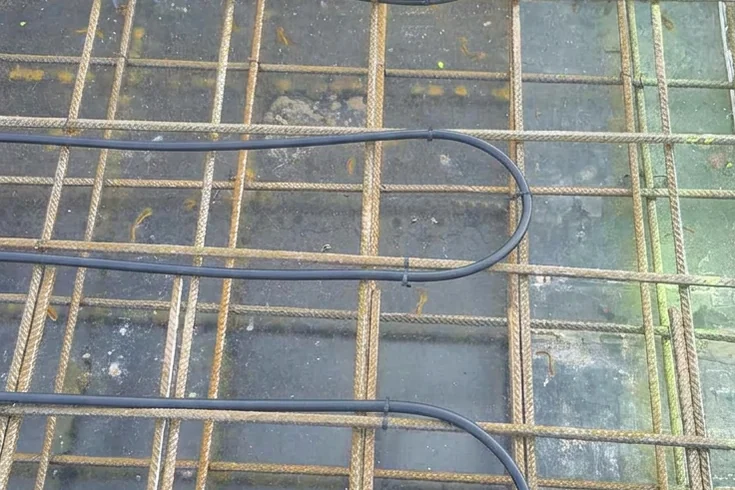
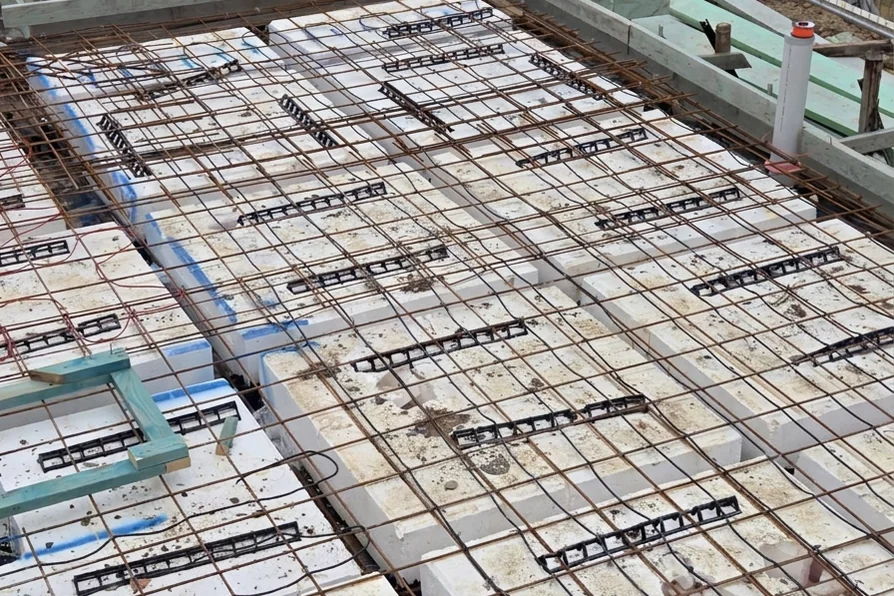
The heating cable is tied to the top layer of the reinforcing mesh with the runs evenly spaced. It is kept clear of walls and floor fixtures, and finished the day before the pour.
The 2m cold tail runs back up a conduit to the thermostat position. A second capped conduit alongside it holds the floor sensor sleeve. The sensor can then be changed later without breaking the floor or walls.
Everything heated stays inside the concrete. The joint between the heating cable and the cold tail is poured in rather than left in the conduit. Four resistance and insulation tests are recorded across the job, the last of them before the thermostat is wired.
Work out your heating area
Measure each room and take off anything permanent. A wardrobe or a kitchen bench does not need heating underneath it, and nothing fixed should be stood on a heated area afterwards.
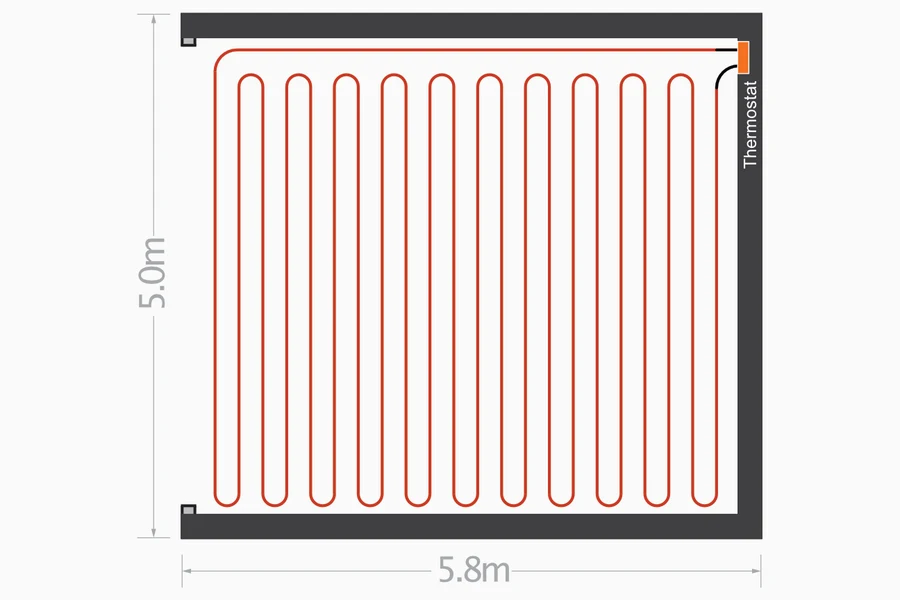
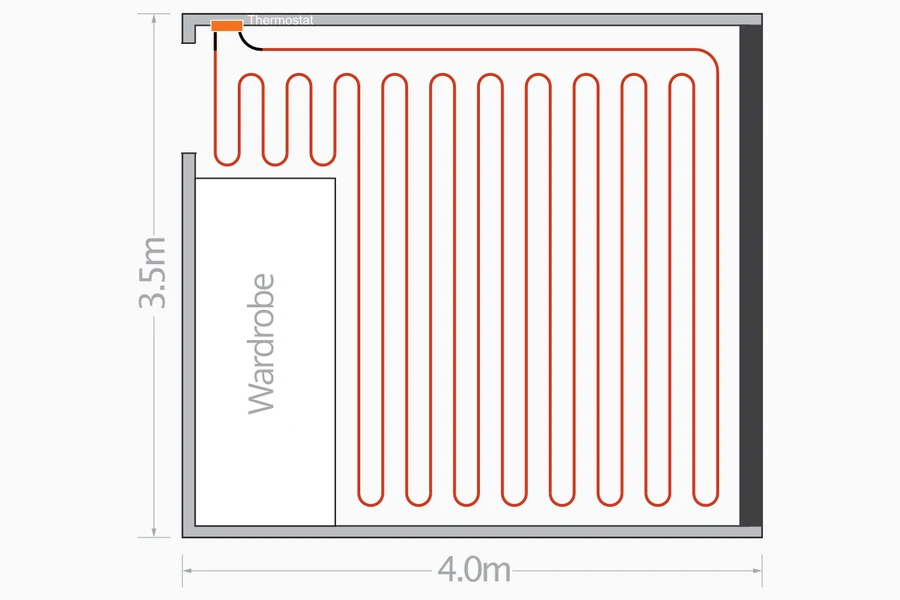
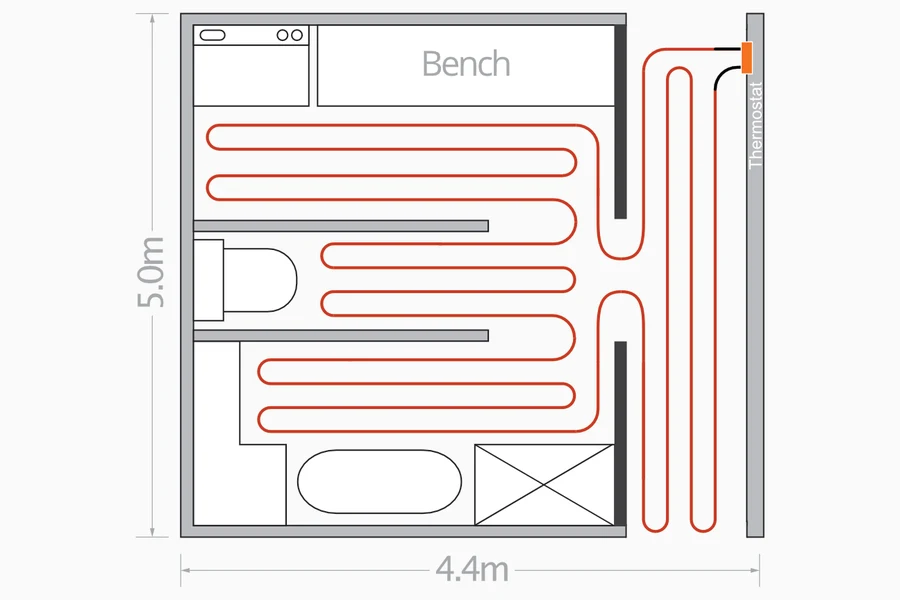
Once you confirm your heating area we can help you match this with a suitable cable size (product)
Compatible floor coverings
The finish choice is the same as any heated slab, polished concrete included. Every covering below is compatible with our dual core slab heating cable.
 Ceramic tiles
 Terracotta tiles
 Marble
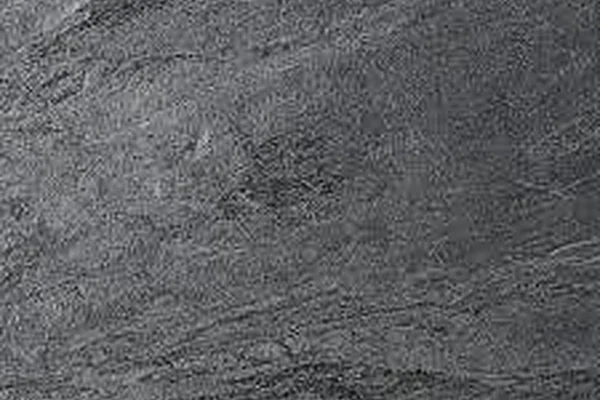 Granite
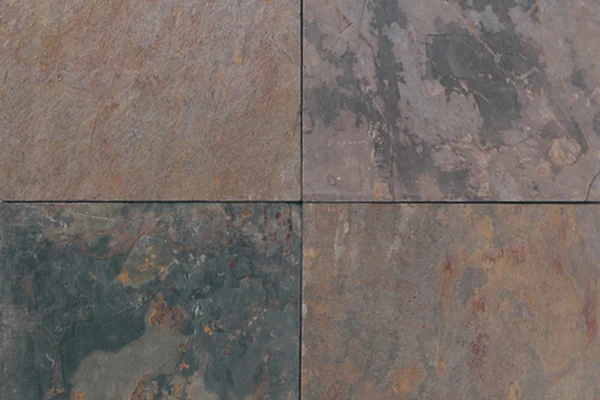 Slate
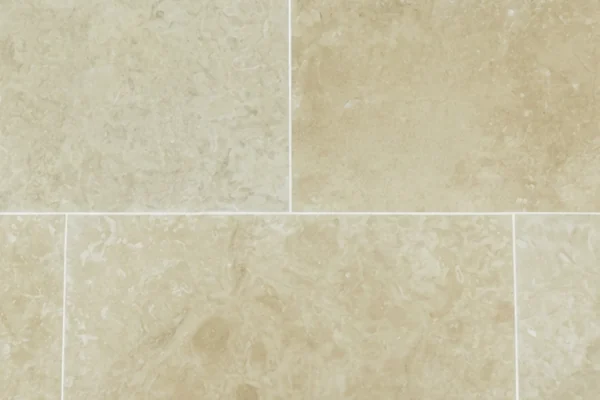 Travertine tiles
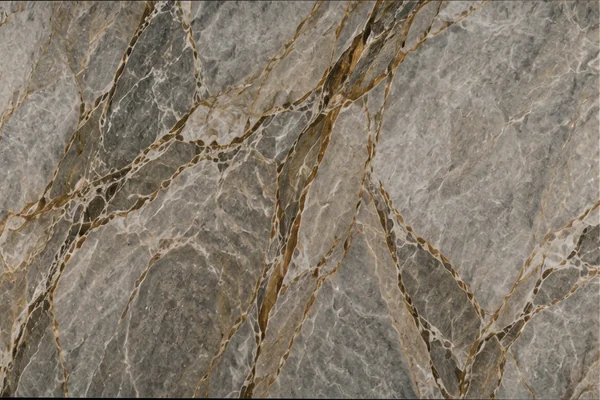 Quartzite floor tiles
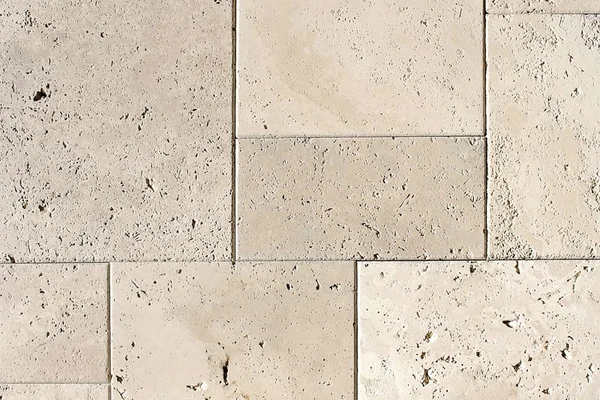 Stone tiles
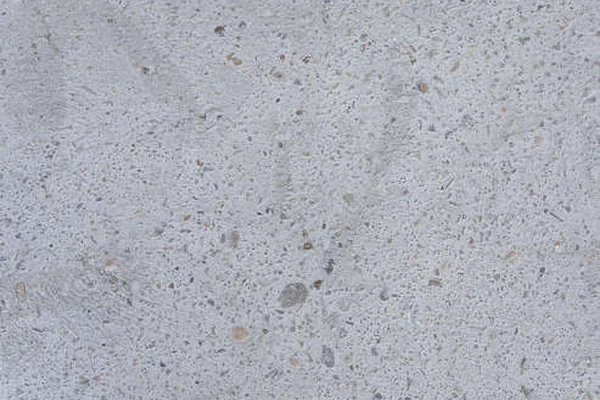 Concrete
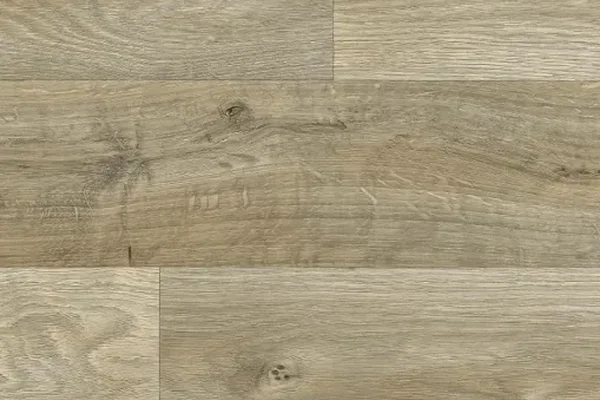 Engineered wood
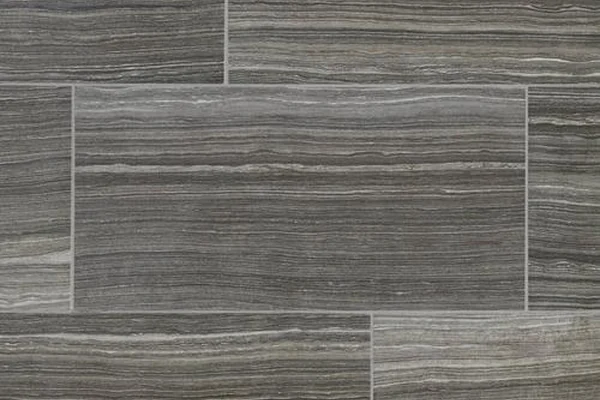 Laminate flooring
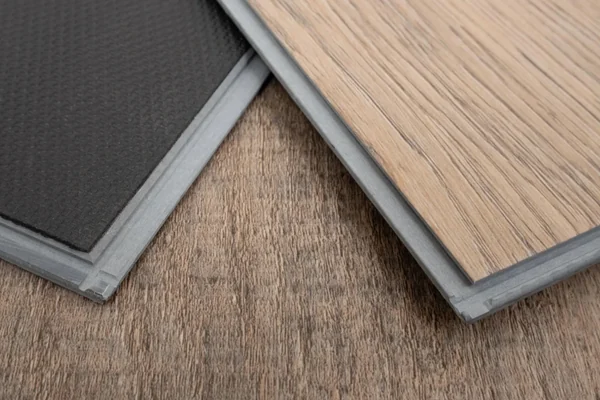 Hybrid flooring
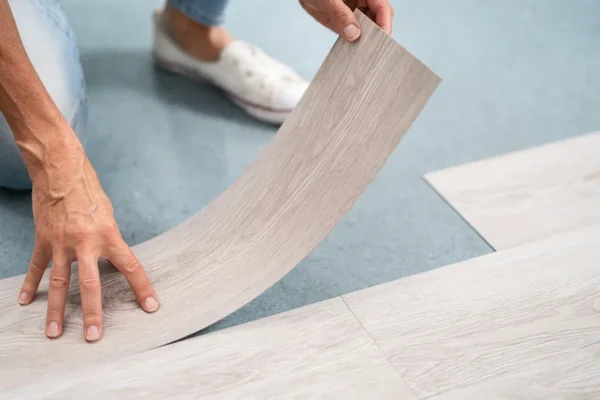 Vinyl flooring
 Carpet
Engineered wood is only laid on a fully dry subfloor. That usually means running the heating first to drive the last of the moisture out of the slab before the boards go down.
Some water based latex adhesives soften above 40°C. Where your tiler uses one, the thermostat is set to a maximum of 25°C.
What the warmth is like
The slab holds the heat and gives it back slowly, so the room sits at an even temperature rather than swinging with a fan.
Because the elements are evenly spaced along the one cable, the output is the same across every run. The floor warms evenly.
Running it on off peak
A heated slab is worth charging when power is cheapest. Every room or zone is controlled by its own thermostat. On a normal tariff, a time clock keeps the heating inside the hours you want to pay for.
Off peak availability depends on your network and your retailer. Some have stopped offering those tariffs to new slab heating customers, so confirm yours early. Solar connection may be suitable.
Why a dual core heated slab is worth having
- Comfortable and safeNo exposed hot surfaces, no flame and no fumes. A floor sensing thermostat holds the floor at a comfortable temperature, which matters in a home with young children or older residents.
- Nothing to service, everThe heating cable is cast into the concrete with no moving parts, no filters and no fan. There is no annual service to book and nothing to replace on a schedule, and the heating cable carries a 20 year warranty.
- Only the hours you chooseEvery room or zone has its own thermostat and its own hours. Nothing is heated that does not need to be.
- Less setting out on siteThe runs go in at 150mm. Only one end comes back to the thermostat rather than both ends returning to where the run started, so an awkward room takes less planning.
- Your floor covering is still your choiceTile, stone, polished concrete, timber, vinyl and carpet all work over a heated slab. Nothing about the covering changes how the heating cable is laid.
- Silent, with no draughtNo fan, no airflow and no duct. Nothing clicks, hums or blows dust around the house. There is no console or vent anywhere in the room to hear or to look at.
Technical details
- Cable type
- Dual conductor heating cable with earth sheath
- Conductor insulation
- FEP Outer Jacket PVC 2 meters /XLPO Cold lead 2 meters
Cold tail length
- 300W to 4500W = 2 meters of 2 core and earth (2.5mm)
- 5400W to 6000W = 2 meters of 2 core and earth (4.0mm)
- Cable diameter
- 7mm
- Operation voltage
- 230V
- Rated Output
- 30W per linear meter
- Max. permissible use temperature-powered
- 60℃
- Max. permissible use temperature-unpowered
- 85℃
- Max. short term temperature
- 240℃ (XLPO Jacket), 90℃ (PVC Jacket)
- Deformation strength
- >1500 NPulling strength >400 N
- Min. installation temperature
- 5℃ for PVC and -15℃ for XLPO
- Min. bending radius
- 6 times cable diameter
- IP Class
- IPX7
- Warranty
- 20 years. See the warranty terms.
Slab heating cable, dual core. 14 sizes.
| Heating area | Output | Cable length | Stock code |
|---|---|---|---|
| 1.5 to 2.9 m² | 0.3 kW | 10 m | DUAL300 |
| 3.0 to 4.9 m² | 0.6 kW | 20 m | DUAL600 |
| 5.0 to 6.9 m² | 0.9 kW | 30 m | DUAL900 |
| 7.0 to 8.9 m² | 1.2 kW | 40 m | DUAL1200 |
| 9.0 to 10.9 m² | 1.5 kW | 50 m | DUAL1500 |
| 11.0 to 12.9 m² | 1.8 kW | 60 m | DUAL1800 |
| 13.0 to 14.9 m² | 2.1 kW | 70 m | DUAL2100 |
| 15.0 to 16.9 m² | 2.4 kW | 80 m | DUAL2400 |
| 17.0 to 18.9 m² | 2.7 kW | 90 m | DUAL2700 |
| 19.0 to 20.9 m² | 3.0 kW | 100 m | DUAL3000 |
| 21.0 to 26.9 m² | 3.6 kW | 120 m | DUAL3600 |
| 27.0 to 32.9 m² | 4.5 kW | 150 m | DUAL4500 |
| 33.0 to 37.9 m² | 5.4 kW | 180 m | DUAL5400 |
| 38.0 to 41.9 m² | 6.0 kW | 200 m | DUAL6000 |
Manuals

Warning! Do NOT cut the heating cable, it cannot be shortened or lengthened.
Common questions
What is the difference between dual core and single core slab heating cable?
A dual core cable carries both conductors inside the one cable and returns internally. One end connects to the thermostat and the other simply stops. A single core cable has to come back to where it started. Dual core is easier to set out in an awkward room. Single core runs at a higher output per metre.
Can dual core cable be installed in an existing slab?
No. Dual core slab heating cable is tied to the reinforcing mesh and poured into the concrete. It only goes in while the slab is being built. To heat a floor that already exists, use an in screed heating cable under a new screed. An under tile heating mat in the tile bed is the other option.
How far apart are the cable runs spaced?
150mm between the runs. The heating cable is tied to the top layer of the slab reinforcing mesh and the concrete is poured over it. How much cable goes in is set by the heating area and the output it needs.
Does dual core cable need two conduits at the thermostat?
Yes, the same as any of our systems. One conduit takes the cold tail up to the thermostat. A second, capped at the end, holds the floor sensor so it can be replaced without lifting the floor. Both go in before the wall is sheeted, which is why the thermostat positions are decided early.
Can I cut a dual core heating cable to fit the room?
No. The heating cable is never cut and cannot be shortened or lengthened. Only the 2m cold tail can be adjusted. Measure each room's heating area first and pick the output that matches it from the table above. Order a second cable rather than trying to make one reach.
What is the warranty on the dual core cable?
20 years on the dual core slab heating cable. That is the heating cable's own warranty and it is the period shown beside the price at the top of this page. Four conditions apply, and they are about how the heating cable is installed rather than who installs it. The conditions, and how to make a claim, are set out in full on our warranty page.
How evenly does the floor warm up?
The floor is warm all over. The heating elements are evenly spaced along the heating cable, and the concrete spreads the heat sideways before it reaches the surface. You do not feel the individual runs underfoot. Spacing the runs correctly at installation is what makes that true.
Which floor coverings can go over dual core slab heating?
Tile, stone, polished concrete, engineered wood, laminate, hybrid, vinyl and carpet all work over a heated slab. A polished slab is the finish this system suits best, since the heat is inside the floor you are polishing. Thick carpet and underlay slow the slab down and are worth keeping thin.
Can a heated slab be the only heating in the house?
Yes, where enough of the floor is heated and the house is insulated to suit. A slab that covers most of the floor area behaves as the house's heater. A slab in one or two rooms is comfort heating. Send us the plans and we will measure the heating areas and tell you which one you are looking at.
Do you supply dual core cable outside Sydney?
Yes. Floor Heating Systems delivers dual core slab heating cable anywhere in Australia. Delivery is free on orders of $100 and over, in 3 to 5 business days, or collect free from Ingleburn. Installation is across Sydney, surrounding NSW and Canberra, subject to checking installer availability.
How long does a dual core slab heating cable last?
We put the working life of the dual core slab heating cable at 25 years or more. The warranty is 20 years, which is a different question from how long it lasts. The working life is how long we expect it to keep heating, and the warranty is what we put right if it fails.